




Recycle Mass Balances: Interactive Simulations and Digital Experiment
The first simulation was prepared using Mathematica. Download the free Wolfram player, and then download the simulation CDF file (link given below or click on figure to download). The second simulation and the digital experiment will run on your browser. Try to predict the behavior when a parameter changes before using a slider to change that parameter. Screencasts below explain how to use these simulations.
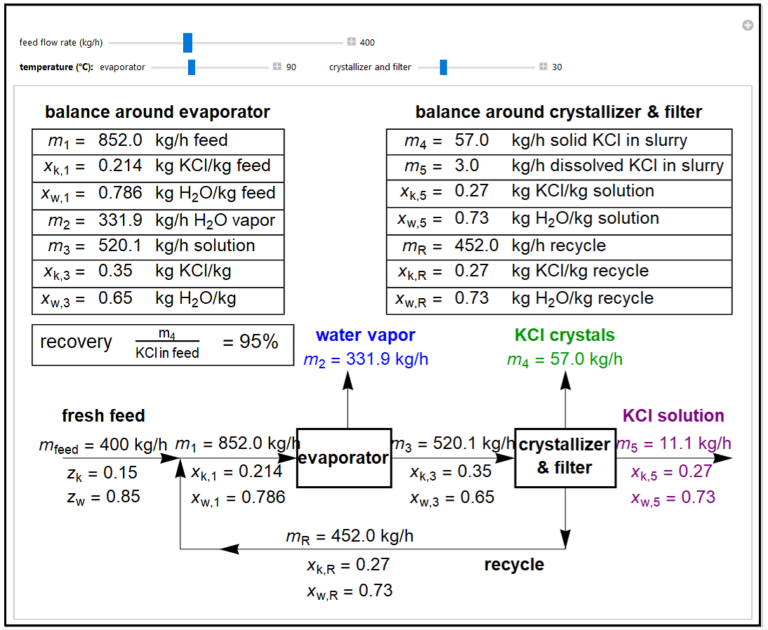
This demonstration shows mass balances for an evaporative crystallization process. A 15% potassium chloride/85% water feed is mixed with a recycle stream and fed to an evaporator, which evaporates water and increases the KCl concentration in the exiting solution. This solution enters a crystallizer and filter. A filter cake of KCl crystals and a portion of the saturated KCl solution are removed from the crystallizer and filter. The rest of the KCl solution is recycled and mixed with the fresh feed. Use sliders to set the fraction of crystals in the product stream, and the temperatures of the evaporator and crystallizer/filter. The solubility of KCl increases linearly with temperature.
Try to answer these questions before determining the answer with the simulation. We suggest that you write down the reasons for your answers.
- What happens when you increase the feed flow rate?
- How does increasing the temperature of the evaporator affect the amount of KCl solution leaving the crystallizer?
Reactor with Recycle Stream

Try to answer these questions before determining the answer with the simulation. We suggest that you write down the reasons for your answers.
- Is the overall conversion of A in a recycle reactor greater than or less than the reactor conversion?
- As the recycle ratio increases, what happens to the overall conversion?
In this experiment, a stream of inert helium containing 0.34 mol% of the reactant tetraethyl orthosilicate (TEOS, Si(C2H5O)4) is fed at a constant rate into a high-temperature reactor, where it produces solid-phase SiO2 and vapor-phase water and ethylene. Silicon dioxide (SiO2) deposits on material surfaces inside the chemical vapor deposition (CVD) reactor. The reactor has a recycle stream and the recycle ratio can be changed. Mass balances are calculated for the system.